All About Diamonds
What they are, how to choose them, and why we chose Lab grown diamonds.

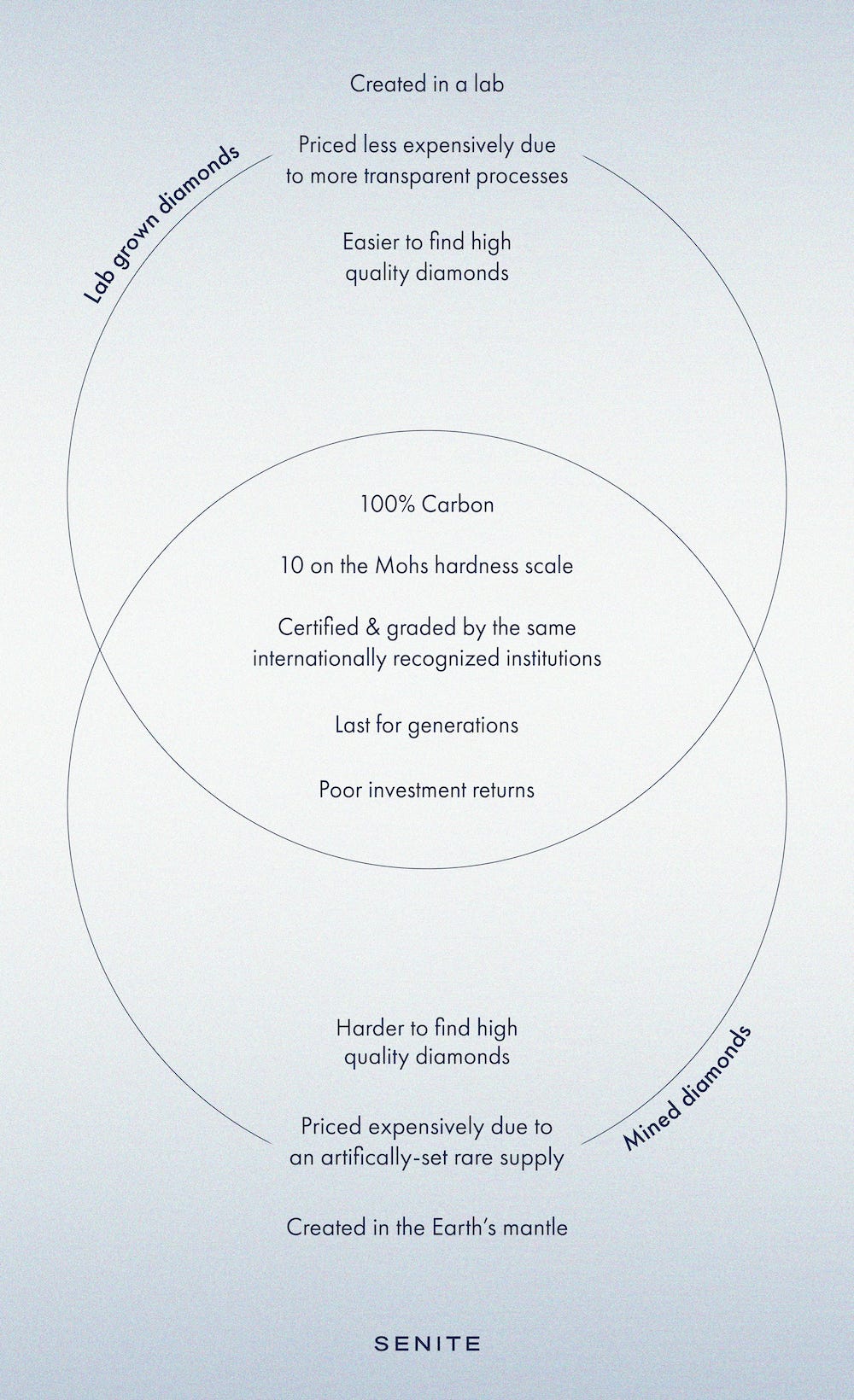
In our Origin Story we touched on how lab grown diamonds are made using either the CVD (Chemical Vapour Deposition) or HPHT (High Pressure High Temperature) method, and how these processes both produce a diamond exactly the same as mined diamonds.
Here we’ll dive further into this, cover how to judge a diamond, and end the myth that diamonds of any kind are good financial investments (yes, we’re being honest about this). We hope you leave with a better understanding of how to buy diamonds and enough information to make sure none of your friends ever end up overpaying for one.
What defines a diamond
If lab grown and mined diamonds are the same, what does that actually mean — what defines what a diamond is?
According to the FTC (the U.S. Federal Trade Commission), diamonds are a mineral made of “essentially pure carbon crystalized in the isometric cubic system”. Basically, a material that is 100% carbon and has a distinct crystal structure. The latter is especially important because graphite is also 100% carbon, but has a totally different coloring and is far less durable. This durability has always been one of the most respected qualities of a diamond, with the name coming from the Greek ‘adámas’, meaning ‘unbreakable’. What gives them this durability? Let’s understand how a diamond is formed.
Mined vs Lab grown diamonds
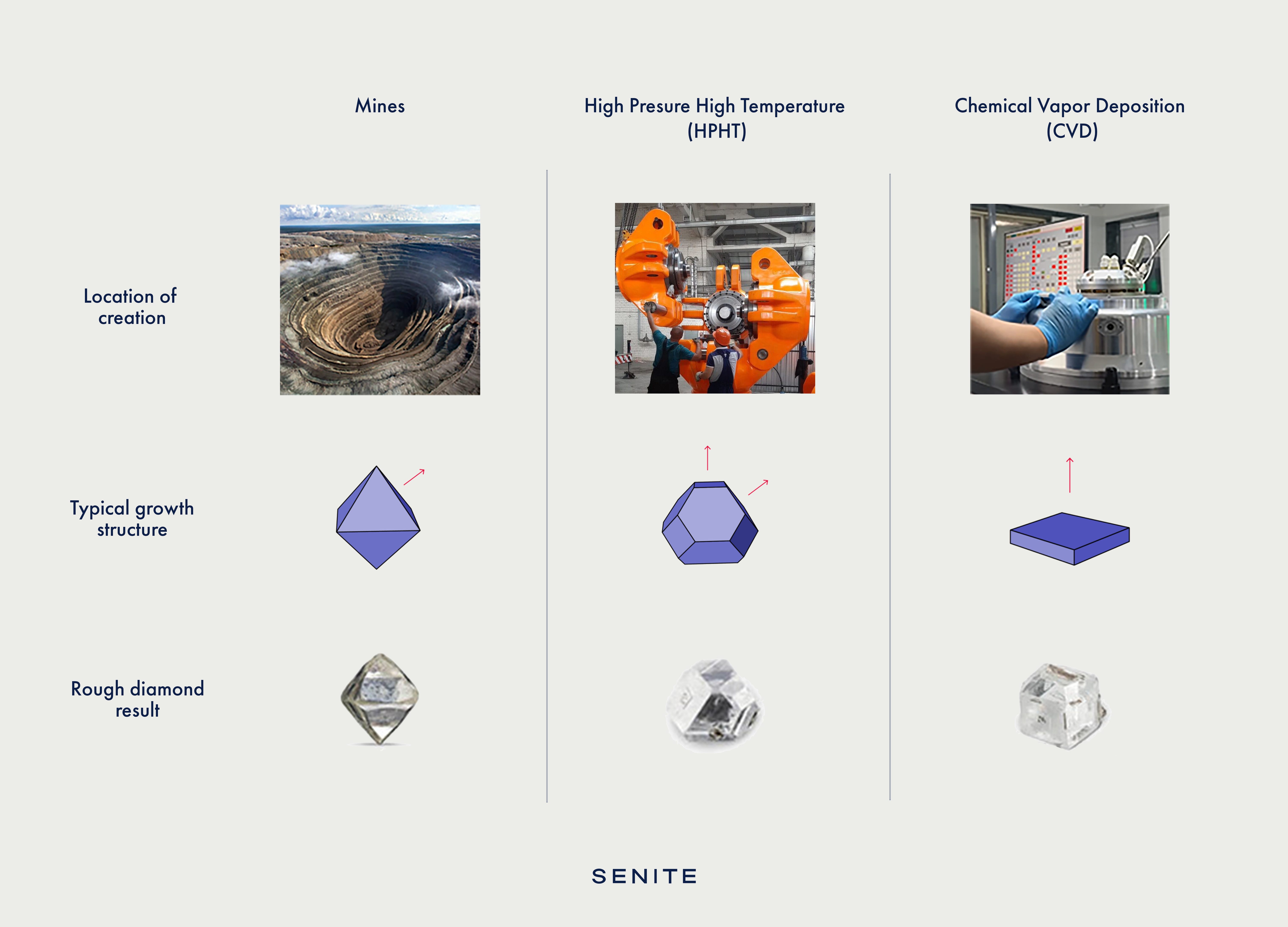
Mined diamonds form in the earth’s layers under high pressure and temperature, some over three billion years ago. Volcanic activity brings them to the surface where they then sit in a rock formation with the potential to be mined. Because of this process, the majority of mined diamonds have trace amounts of other substances, like Nitrogen, which gives them a yellow tint. These trace elements can add to their uniqueness, like enough Nitrogen creating beloved yellow diamonds, but they usually get in the way. That’s part of the reason why controlling these elements in a lab leads to higher quality diamonds.
Lab grown diamonds mimic the earth’s process with HPHT (we’ll get to the CVD process in a bit). With High Pressure High Temperature, diamonds are created by placing a diamond seed in a chamber, adding another carbon source around that seed, and then heating that chamber to a brisk 1300-1600°C and placing an easy 870,000 pounds/square inch of pressure on it. As that other carbon source melts and cools on top of the diamond seed, it combines and crystallizes over several weeks to form a diamond.
The other lab grown diamond process, CVD, also uses a chamber and diamond seeds, but instead of adding another solid Carbon source, they fill the much smaller chamber with a gas that when heated, rains down Carbon onto the seeds and layer by layer becomes a diamond.
Both result in 100% carbon rough diamonds that are then cut and polished to be used in jewelry like ours.
Is one lab grown process better than the other? The short and long answer — no. Since both HPHT and CVD diamonds (and mined diamonds) are graded on the same scale, whatever the GIA (Gemological Institute of America) or IGI (International Gemological Institute) grade it as, that’s what it is. There’s no such thing as a D Color HPHT diamond — it's just considered a D color diamond.
In terms of popularity, CVD has been growing as its technology improves, since it’s less energy-intensive and expensive than HPHT. But even with this rise, CVD diamonds are sometimes given an HPHT post-growth treatment to enhance the color or clarity of them, illustrating how both can be used in one diamond. With HPHT technology first creating a diamond in 1954, to then first creating a gem-quality diamond in 1971, and CVD coming on to the scene in the 1980s, this combination of the processes might be the future of all lab grown diamonds — helping show that neither is better than the other. But for those who are curious, the certification you receive from the GIA or IGI will state which growth process your diamond came from.
Judging a diamond — the 4 C’s
Now that we know how mined and lab grown diamonds are chemically and physically the same, how do we judge their quality?
Developed by Robert M. Shipley, a jeweler and founder of the GIA, the 4 C’s were his way of standardizing diamond characteristics in a way that would be easy to remember. Before this, retailers across the world used a variety of terms, like ‘river’ for colorless diamonds, and ‘made well’ vs ‘made poorly’, and while these were more conversational (and arguably more fun), the standardization helped make sure customers were on the same page with retailers in understanding what they were buying.
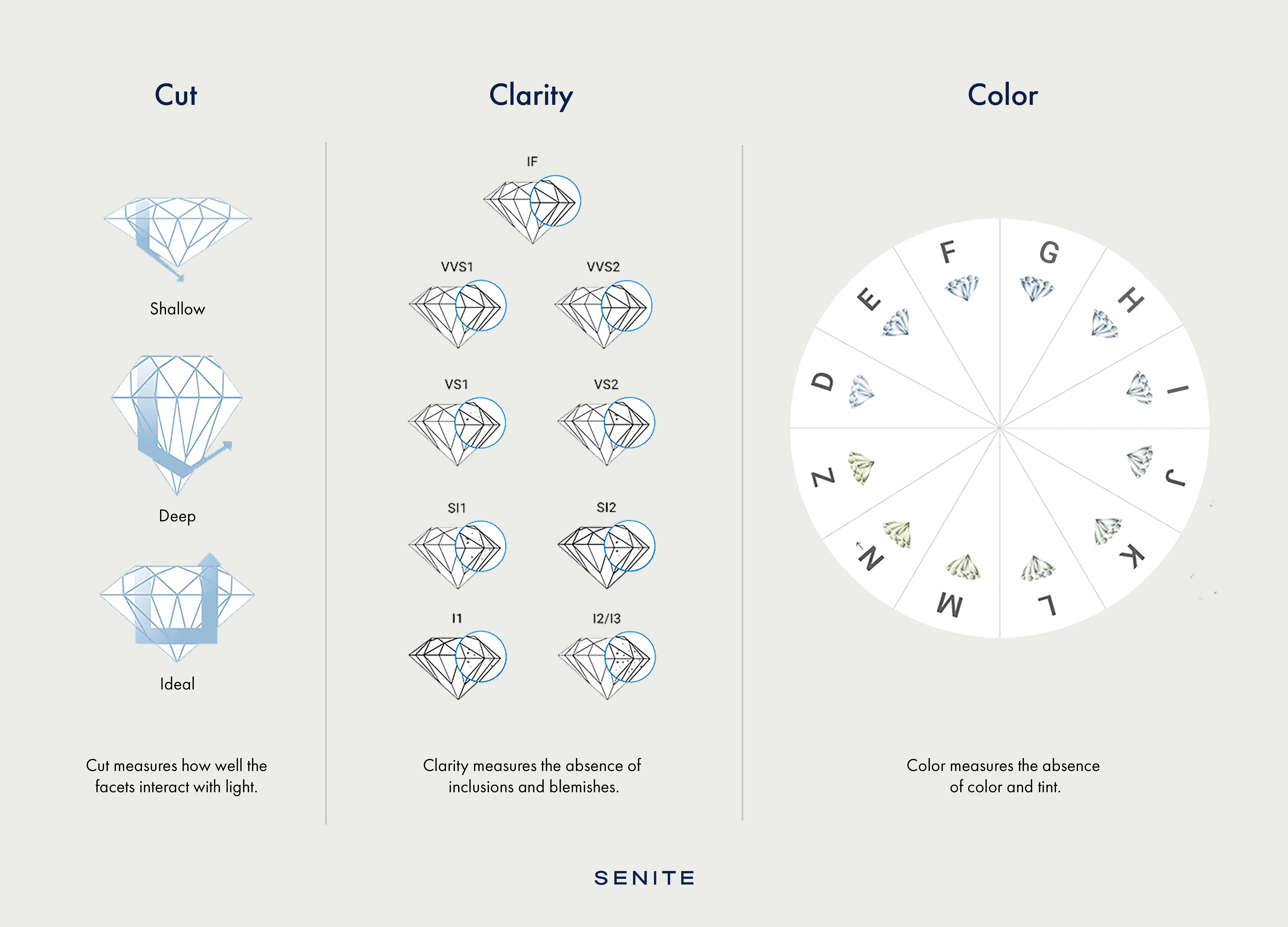
The 4 C’s grew with DeBeers’ marketing campaigns and with further clarifications from GIA successors that simplified grading scales, and today it is the universal standard of judging a diamond, with the IGI also using it. So what are the 4 C’s? Color, Clarity, Cut, Carat.
Color:
Measures the absence of color
Uses a scale from D-Z, D being colorless
Clarity:
Measures the absence of inclusions and blemishes
Uses a scale from FL (Flawless) – I3 (Included)
Cut:
Measures how well a diamond’s facets interact with light
Uses a scale of Excellent, Very Good, Good, Fair, and Poor
Carat:
Measures the weight of the diamond
One Carat = 0.2 grams
How important is each one? It depends. From these Reddit threads it’s clear that to the naked eye, the differences in Color and Clarity grades aren’t always clear. Cut can be affected by how much sparkle you want your diamond to have (yes, we’ve actually played with pieces we thought were a bit too glittery), and Carat can look different based on who’s wearing it (if I wear our 2tcw Stud Earrings with my small earlobes, I feel too much like Carmela Soprano, who I love, but isn’t always my everyday energy).
So while some grades might not be perceptible to everyone, for us, a big part of our excitement and belief in lab grown diamonds comes from its ability to have the highest grades, with not the highest prices. This is why all our pieces contain diamonds with minimum F Color, VS Clarity, and Very Good Cuts, with Carat size varying based on the designs and what we felt were most fitting for everyday wear.
What about choosing the best diamond grades for investment purposes?
A diamond’s investment value, or rather their lack of
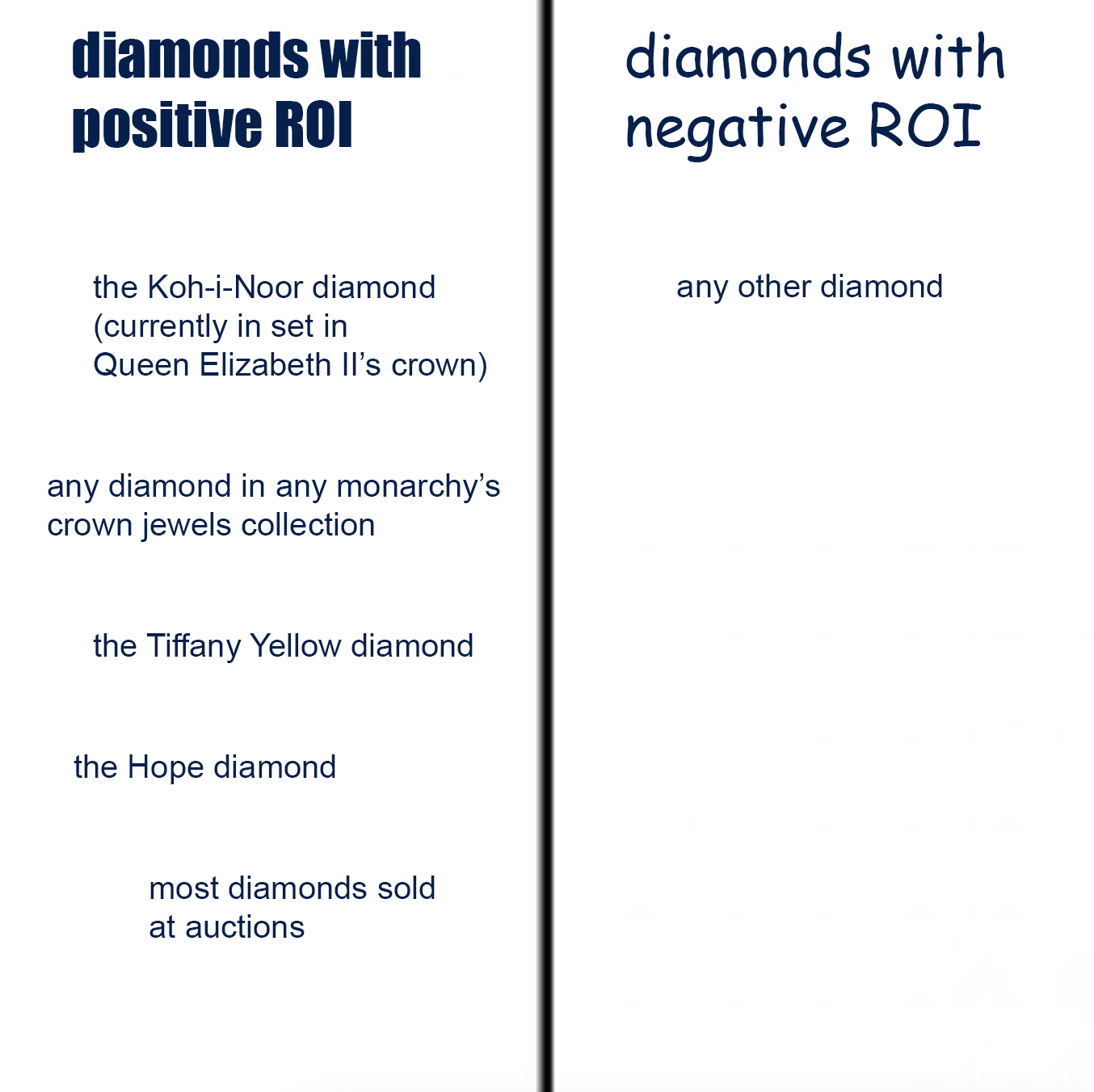
One of the biggest arguments against lab grown diamonds is that they don’t have the same investment value as mined diamonds. The reality though is that neither are strong investments.
Like cars, the rule is that once you leave the dealer, your item will drop by at least 50% in value, largely due to retail cost markups and marketing, but there are also two other main factors that explain why the resale value is so low for both mined and lab grown diamonds.
Inability to alter diamonds - Unlike gold which can be melted down to create new pieces, diamonds, with their beloved durability, can only become new pieces with a lot of labor, like combining them with other gems to create a larger piece of jewelry, or breaking them down into smaller pieces, but that decreases their value even further.
Lack of secondhand market - Thanks to the nature of most diamond jewelry purchases relating to romance, there isn’t a standard secondhand market, meaning there aren’t enough set prices to compare to. Conveniently enough as well, DeBeers’ campaign to push diamonds as engagement rings with ‘A diamond is forever’ also helped prevent a secondary market that would reveal how much diamonds are really worth.
With diamond investment, there are exceptions to the rule of course, like diamonds with rare colors or histories, but in general, diamonds should not be bought with investment value in mind. They’re durable, sparkly pieces of luxury that, when combined with metals like 18k white gold, become pieces of fine jewelry that will last for lifetimes. They’re not investment pieces — they’re for more brilliant everydays.
With a little diamond seed and decades of innovation, lab grown diamonds have allowed high-quality diamonds to exist beyond a price point DeBeers artificially set. When you’re ready to buy a diamond, we recommend you choose the one that looks and sparkles the way you like, at a price point you’re happy with, because now you have the option.